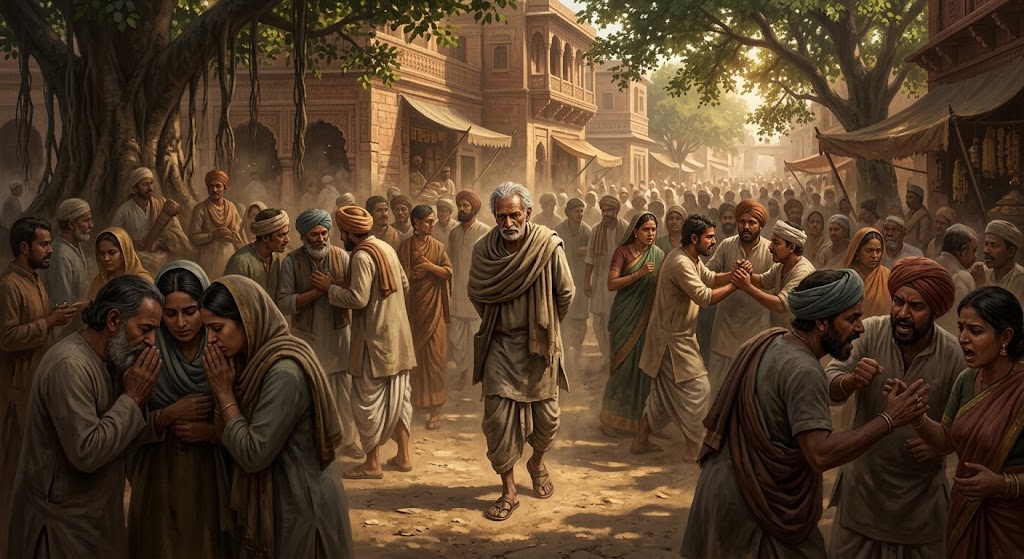
There was a commotion in the city of Kapilavatthu. Wherever you looked, everyone was talking about a heavy topic. In some places, people were speaking in grave, serious tones; in others, they were clapping their hands, bumping into one another, crowding together, whispering, groaning, and making a great noise. No one had any idea or thought about anything else happening around them.
Amidst the townspeople talking in clusters along the streets, near market corners, and under the shade of trees, a person was moving forward with difficulty. He was a person of somewhat advanced age. His upper body was bent slightly forward, his hands clasped behind his back, walking with heavy steps as if carrying an unbearable burden on his head.
He walked through the people on the street without stopping or pausing. It was clear to anyone looking that he did not have the necessity to engage in serious talk or to express excitement like the others in Kapilavatthu.
His destination was not a secret to anyone. It was the Nigrodharama monastery, the sacred ground where the Arahants of Kapilavatthu resided. He was approaching the city step by step to meet the Tathagata, the Blessed Buddha. He knew that the Blessed One was residing in this monastery during these days. He knew that the ability to dispel the doubts arising in his mind lay solely with Him. Therefore, he approached the fragrant hut where the Buddha was staying, and after entering and taking a seat respectfully to one side, he addressed his deep thoughts:
"O Lord, today the entire city of Kapilavatthu is in quite a commotion. Many people are gathering in various places, mocking and talking about a discourse of yours."
"Mahanama, what is the mockery? What is the mockery concerning?"
"Lord, is it true that the Tathagata declared that the Sakyan named Sarakani has become established in the Stream-Entry fruit?"
"That is true, Mahanama. If the Tathagata states something about someone, it is not false; it is a fact. It is true that Sarakani has attained Stream-Entry and passed away."
"O Lord, the talk going around Kapilavatthu today about this has become a subject of mockery for many. How can someone who drank so much intoxicants become a Stream-Enterer? If that is possible, how can anyone not be able to become one? If such a famous drunkard can become a Stream-Enterer, who cannot? People are talking with mockery like this, Lord."
At this occasion, the Buddha explained the reasons why the Sakyan named Sarakani attained Stream-Entry. Based on those points, the factors connected to the Stream-Entry fruit are summarized below:
The word "Sotapanna" is a compound formed by joining two words: "Sota" and "Apanna". Sota refers to the stream, which is the Noble Eightfold Path. Apanna means entering. Thus, Sotapanna means entering the stream that is the path to Nibbana.
In another sense, Sota refers to the Noble Eightfold Path, and Sotapanna means entering the Noble Eightfold Path. Accordingly, there are eight streams, namely:
- Samma Ditthi Sotasya (Right View stream)
- Samma Sankappa Sotasya (Right Intention stream)
- Samma Vaca Sotasya (Right Speech stream)
- Samma Kammanta Sotasya (Right Action stream)
- Samma Ajiva Sotasya (Right Livelihood stream)
- Samma Vayama Sotasya (Right Effort stream)
- Samma Sati Sotasya (Right Mindfulness stream)
- Samma Samadhi Sotasya (Right Concentration stream)
Entering the Noble Eightfold Path means fulfilling the following three (03) conditions:
- Adisila (Higher morality)
- Adicitta (Higher mind / concentration)
- Adhipanna (Higher wisdom)
There are four factors that must be practiced and cultivated to attain Stream-Entry, according to the teachings of the Dhamma:
- Satpurupa Sevanaya (Association with good/noble people)
- Saddhamma Sravanaya (Listening to the True Dhamma)
- Yonisomanasikaraya (Wise attention / proper reflection)
- Dhammanudhamma Patipada (Practice in accordance with the Dhamma)
These four factors are also known as the factors of Stream-Entry (Sotapatti Anga).
One who aspires to attain Stream-Entry must develop the five spiritual faculties (Panwa Indriya) and the five spiritual powers (Panwa Bala). The five spiritual faculties are:
- Saddha Indriya (Faculty of Faith)
- Viriya Indriya (Faculty of Energy/Effort)
- Sati Indriya (Faculty of Mindfulness)
- Samadhi Indriya (Faculty of Concentration)
- Panna Indriya (Faculty of Wisdom)
By cultivating and developing the faculties listed above, they grow into spiritual powers. Developing the faculty of faith causes it to grow as a power, and similarly for energy, mindfulness, concentration, and wisdom. When all these faculties are cultivated as powers, they can be classified as the five powers:
- Saddha Bala (Power of Faith)
- Viriya Bala (Power of Energy)
- Sati Bala (Power of Mindfulness)
- Samadhi Bala (Power of Concentration)
- Panna Bala (Power of Wisdom)
There are four prominent characteristics evident in a Stream-Enterer who has entered the Noble Path:
- Unshakable faith regarding the Buddha
- Unshakable faith regarding the Buddha's Noble Dhamma
- Unshakable faith regarding the Noble Sangha
- Possession of unbroken, unblemished, noble virtues dear to the noble ones
Unshakable faith in the Triple Gem, combined with noble-virtued character, qualifies a person for attainment of the Stream-Entry fruit.
The texts mention the Maha Pratyavekshana Jnana (Great Insight/Reviewing Knowledge) experienced by one who attains the Stream-Entry fruit. There are seven types of Maha Pratyavekshana Jnana listed:
- The reviewing knowledge of knowing that the mind is well-established to understand the Deathless State.
- The reviewing knowledge of knowing that the path's Right View has been cultivated, generating mental balance within oneself.
- The reviewing knowledge of reflecting that any noble visionary who follows behind one is not excluded from this dispensation.
- The reviewing knowledge of reflecting that a person endowed with the path's vision enters moral restraint thinking, "Just as he is, so am I".
- The reviewing knowledge of reflecting that a person endowed with vision desires to dwell with expectations of observing the various trainings (Sikkha) such as Adisila, Adicitta, and Adhipanna, thinking, "I am also like that".
- The reviewing knowledge of reflecting that when a person with path vision listens to the Tathagata's Dhamma, they listen with a well-settled mind, thinking, "Such an ability is within me; I am a person endowed with such power".
- The reviewing knowledge of a person endowed with path vision who listens to the Tathagata's Dhamma, experiencing both the meaning and the Dhamma combined is there joy, and am I endowed with such joy?"—this is the insight of reflection.
The noble disciple who attains the Stream-Entry fruit is freed from three primary fetters (sanyojana dharma), which are:
- Sakkaya Ditthi (Identity view)
- Vicikiccha (Skeptical doubt)
- Silabbata Paramasa (Adherence to wrong rites and rituals)
The Dhamma teaches about two types of individuals who train to eradicate these fetters and attain the Sotapatti fruit:
- Saddhanusari Puggala (Faith-follower)
- Dhammanusari Puggala (Dhamma-follower)
The Dhamma also teaches about three types of individuals according to how they progress from the Sotapatti path towards Nibbana:
- Sattakkhattu-paramo Puggala (Seven-times-bound-at-most individual)
- Kolan-kola Puggala (Family-to-family individual)
- Eka-biji Puggala (One-seed individual)
In addition to these, twenty-seven (27) categories of Stream-Entering individuals have been categorized.
It is also shown that six (06) blessings are obtained by the noble disciple who has attained the Stream-Entry fruit:
- Invariable inclination toward the True Dhamma
- Possessing unblemished qualities
- Having no more recurrence of suffering regarding eradicated defilements
- Endowed with peerless wisdom
- Seeing causes properly
- Seeing well-born phenomena properly
That noble disciple—whose unwavering faith in the Triple Gem persists, whose virtue is unbroken, untorn, unblemished, free from defilements, and praised by the wise—is said to possess the virtue dear to the noble ones. This is expressed by themselves as follows:
- I am free from hell.
- I am free from the womb of animal rebirth.
- I am free from the realm of ghosts (peta).
- I am free from the states of deprivation and woe (apaya dugati).
- I possess the nature of not falling into hell, and I am a Stream-Enterer established firmly in definite enlightenment.
The Blessed One addresses the Sakyan Mahanama:
"Mahanama, how can a lay follower who has for a long time taken refuge in the Buddha, Dhamma, and Sangha go to a woeful state? Sarakani was also a lay devotee. How could he go to a woeful state?"
"Even these visible, great sal trees, if they could understand what is well-spoken and ill-spoken, wouldn't these very sal trees fall into the woeful state—let alone a Stream-Enterer who is established in the certainty of future Arahantship?"
"Although Sarakani was known as a heavy drinker, he spent the time close to his death fulfilling the higher trainings (trividha siksha)."
"Mahanama, he passed away as a noble Stream-Enterer."