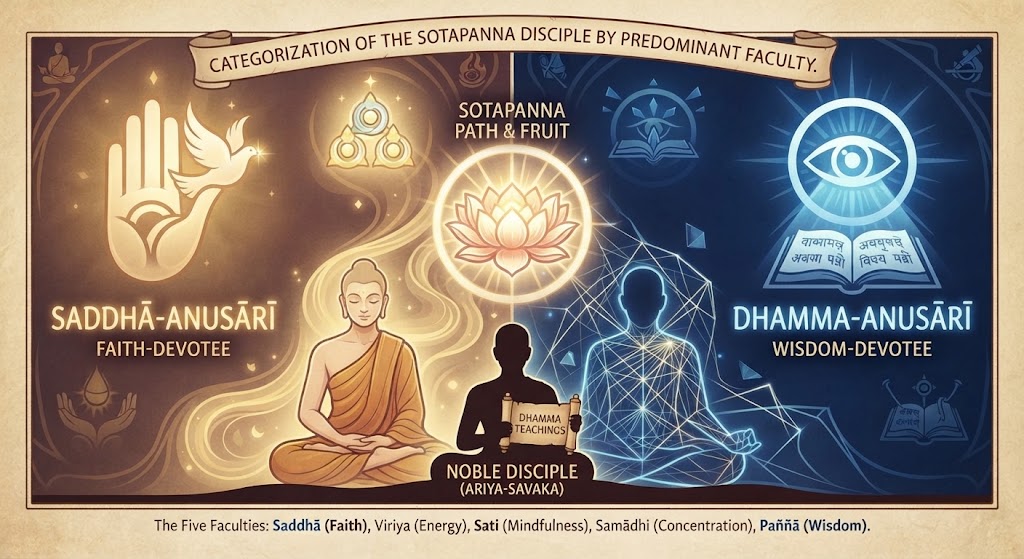
Individuals who develop the faculties (indriya dhamma) attain the supreme realization of Nibbana by obtaining the path and fruit and eradicating all inflows (asava). The manner in which the noble disciple who has heard the teachings must prepare for it and develop their virtuous qualities has been detailed in previous chapters. To attain the Sotapanna state, the noble disciple who cultivates the spiritual faculties is categorized into two (02) types based on the predominant faculty at the time of reaching the Sotapanna path. Namely:
- Saddanusari Person (Faith-follower)
- Dhammanusari Person (Dhamma-follower)
Furthermore, based on the duration or time period it takes to attain the realization of Nibbana after reaching the Sotapanna state, the Sotapanna noble disciple is divided into three (03) categories. Namely:
- Ekabiji (One-seed)
- Kolankola (Family-to-family)
- Sattakkhatthupama (Seven-times-at-most)
Based on these foundational aspects of reaching the Sotapanna state, there are two types of noble disciples on the Sotapanna path and three types of noble disciples who have attained the Sotapanna fruit. A concise overview of these categories is presented below.
01. The Saddanusari Person
A person who primarily relies on faith while cultivating the spiritual faculties is known as a Saddanusari. The Saddanusari disciple is not yet a person who has attained the Sotapanna fruit; rather, they are on the Sotapanna path (magggastha). The Saddanusari noble disciple is destined for absolute purification and supreme awakening. They progress by cultivating faith and spiritual faculties based on the exposition of the Dhamma.
"Katamo ca, bhikkhave, puggalo saddanusari?
Idha, bhikkhave, ekaccassa puggalassa ye te sakkayaditthippahana asavahiti ahana darsana pahatabba dhamma, te tathagatassa dhamma pannyaya anuparikkhanti, tasseta dhamma pannyaya anuparikkhiyamana khanti hoti... saddindriyam, viriyindriyam, satindriyam, samadindriyam, pannyindriyam. Ayam vuccati, bhikkhave, puggalo saddanusari. Imassapi kho ahang, bhikkhave, bhikkhuno 'appamadena karonyanti vadami. Ta kissa hetu? Appevo nama ayamayasma anupubbisena senasanani patisevamano kalyanamittam bhajamano indriyani samannaharamano - yassatthaya kulaputta sammadeva agarasma anagaram pabbajanti, tadevaduttaram - brahmacariyapariyosanam - dittheva dhamme sayam abhiyya sacchikatva upasampajja vihareyyati! Imo kho ahang, bhikkhave, imassa bhikkhuno appamadatulam sampassamano appamadena karonyanti vadami."
"And who, bhikkhus, is the faith-follower (saddanusari)? Here, bhikkhus, regarding a certain person, the teachings that must be eradicated by vision (insight)—which are abandoned with the destruction of identity-view—are examined with wisdom in accordance with the Tathagata's teachings. As they examine these teachings with wisdom, patience (acceptance) arises... [These faculties are] faith faculty, energy faculty, mindfulness faculty, concentration faculty, and wisdom faculty. This person is called a faith-follower, bhikkhus. Regarding this monk too, I declare: 'Do your duties with diligence!' Why is that? Hoping that this venerable one, step by step, by frequenting suitable dwellings, associating with noble friends, and balancing the faculties, will realize and attain that supreme goal of the holy life—for the sake of which clansmen rightly go forth from home into homelessness—here and now, by his own direct knowledge. Seeing this diligence for this monk, I declare: 'Do your duties with diligence!'"
— Samyutta Nikaya, Mahavagga, 248th Page, Burmese Ed.
Based on this inquiry, the Saddanusari noble disciple does not generate...
...rupa-sphere or arupa-sphere jhanas, nor are they a person who has destroyed the inflows through profound wisdom. What they possess is a foundation of faith and a foundation of affection toward the Blessed One.
The Saddanusari noble disciple who has entered the Sotapanna path accepts the Dhamma of the Buddha not by seeing it directly with supreme wisdom, but by accepting the words of the Buddha just as they are. They engage wisdom regarding the Buddha's word, observing it through wisdom, but their predominant inclination is to accept the Buddha's word through faith.
Because the Saddanusari person is on the Sotapanna path, they understand that they must act diligently to attain the Sotapanna fruit. Several points regarding how diligence and energy should be developed are set out below, which can be summarized as follows:
- Frequenting suitable, secluded lodgings
- Associating with noble friends (kalyana mitta)
- Keeping the five spiritual faculties balanced
By engaging diligently in the path of the holy life, one can attain the path and realize Nibbana in this very lifetime.
There is another special condition regarding the Saddanusari person: this person does not die while remaining merely at the Saddanusari level without reaching the Sotapanna fruit. That is a fixed Dhamma (niyata dhamma); they definitely attain the Sotapanna fruit.
02. The Dhammanusari Person
The second person journeying on the Sotapanna path is the Dhammanusari (Dhamma-follower). They place wisdom at the forefront while cultivating the spiritual faculties and performing tasks on the Sotapanna path.
...They are an individual who is engaged in the Sotapanna path. The constituents of the Sotapanna state are developed by placing the wisdom faculty at the forefront.
The nature of this noble disciple on the Sotapanna path as a Dhammanusari is clarified by the Blessed One as follows:
"Katamo ca, bhikkhave, puggalo dhammanusari?
Idha, bhikkhave, ekaccassa puggalassa ye te sakkayaditthippahana asavahiti ahana darsana pahatabba dhamma, te tathagatassa dhamma pannyaya anuparikkhanti, tassa te dhamma pannyaya anuparikkhiyamana khanti hoti... saddindriyam, viriyindriyam, satindriyam, samadindriyam, pannyindriyam. Ayam vuccati, bhikkhave, puggalo dhammanusari. Imassapi kho ahang, bhikkhave, bhikkhuno 'appamadena karonyanti vadami. Ta kissa hetu? Appevo nama ayamayasma anupubbisena senasanani patisevamano kalyanamittam bhajamano indriyani samannaharamano - yassatthaya kulaputta sammadeva agarasma anagaram pabbajanti, tadevaduttaram - brahmacariyapariyosanam - dittheva dhamme sayam abhiyya sacchikatva upasampajja vihareyyati! Imo kho ahang, bhikkhave, imassa bhikkhuno appamadatulam sampassamano appamadena karonyanti vadami."
"And who, bhikkhus, is the Dhamma-follower? Here, bhikkhus, regarding a certain person..." (Similar doctrinal explanation continued)
Here too, the Dhammanusari noble disciple does not generate rupa or arupa jhanas, nor are they someone who has destroyed all inflows through profound wisdom. What they possess is the direct understanding through their own wisdom of the Dhamma taught by the Blessed One.
...They establish faith in the Blessed One by making wisdom foundational. They examine and accept the Dhamma taught by the Blessed One using their own wisdom, and they cultivate faith and other spiritual faculties by using the Dhamma investigated through wisdom as their foundation.
This disciple, engaged in cultivating the Dhamma by examining it with wisdom as a Dhammanusari, is not a person who remains stalled on the Sotapanna path; rather, they fulfill the practice of the Sotapanna path. Therefore, they receive the advice of the Blessed One that they must act with diligence. Just as explained under the Saddanusari, the Dhammanusari person is also advised to frequent suitable secluded lodgings, associate with noble friends, and keep the five spiritual faculties balanced to act with diligence.
By engaging diligently in the path of the holy life, one can attain the path and realize Nibbana in this very lifetime.
There is also a special condition to be noted regarding the Dhammanusari person: they do not die while remaining only at the Dhammanusari level without reaching the Sotapanna fruit. That is a fixed Dhamma (niyata dhamma); they definitely attain the Sotapanna fruit.
The noble disciple who has attained the Sotapanna fruit by being a Dhammanusari is known as ditthipatta (vision-attained), whereas the noble disciple who has attained Nibbana while being a Saddanusari is known as saddhavimutta (faith-liberated).
- According to the time of seeing Nibbana: Sotapanna disciples who are Saddanusari and Dhammanusari fulfill the diligent practice in this very life and realize the Sotapanna fruit. There is no lifetime that blocks the attainment of the Sotapanna fruit, and they proclaim that they will attain the realization of Nibbana within seven lives at most.
...Noble disciples who realize Nibbana, culminating in the Arahant fruit, are presented in three categories. Namely:
- Ekabiji (One-seed)
- Kolankola (Family-to-family)
- Sattakkhatthupama
- Ekabiji: This is the name given to the noble disciple who attains the Sotapanna fruit in this very life and, advancing further with diligence, realizes Nibbana by attaining the remaining path fruits in this very same life. No second lifetime is required for the realization of Nibbana; all path fruits are attained in this very lifetime.
- Kolankola: This is the name given to the second type of Sotapanna noble disciple. Kola refers to a family (lineage or birth). A Sotapanna individual has the capacity to wander in samsara for up to seven lives. However, the Kolankola person does not wander through all seven lives; they wander through two, three, or fewer lives in samsara before attaining the realization of Nibbana, and thus are known as Kolankola persons.
- Sattakkhatthupama: The third type of Sotapanna noble disciple is known as Sattakkhatthupama. Having severed the three fetter-dhammas—identity-view (sakkaya ditthi), skeptical doubt (vicikiccha), and attachment to rites and rituals (silabbataparamasa)—they attain the Sotapanna state in this very lifetime. If they are unable to attain the other path-fruits and realize Nibbana within this very life, they will never fall into the woeful states in a second life, but are definitely bound for fortunate destinations (sugatigamiya). Until they attain the realization of Nibbana .a being takes divine or human lives, practicing the path meditation to make all suffering cease, and ultimately realizes Nibbana in the seventh lifetime. The noble disciple who attains the Sotapanna path and takes birth up to seven times before realizing Nibbana in the seventh life is known as Sattakkhatthupama.
Thus, the noble disciple who enters the Sotapanna path as either a Saddanusari or a Dhammanusari and attains the Sotapanna fruit in this lifetime is known as an Ekabiji if they see Nibbana within this lifetime after destroying the remaining seven fetter-dhammas, as a Kolankola if they see Nibbana within six lives, or as Sattakkhatthupama if they see Nibbana after wandering through all seven lives.
- Vulla Sotapanna
What is referred to as Culla Sotapanna is the preliminary stage preceding the attainment of the Sotapanna state. The preliminary stages prior to becoming a Sotapanna have been shown earlier as the Dhammanusari and Saddanusari. That is the usage found in the Tipitaka. However, there is also a traditional usage of the term Culla Sotapanna. That is found in the Visuddhi Magga authored by the Elder Buddhaghosa and other commentary masters. It states that a noble disciple who has attained kabbavitarana visuddhi (purity by overcoming doubt) is certain of a fortunate destiny even if they have not yet reached the Sotapanna fruit-attainment; therefore, they are referred to as a Culla Sotapanna. This is not the previously mentioned Saddanusari or Dhammanusari, but a prior stage.
Thus, based on the manner of entering the Sotapanna path, noble disciples can be recognized as two types, and based on the manner of attaining the realization of Nibbana after reaching the Sotapanna fruit, noble disciples can be recognized as three types.