Manasikara Dhamma
For the realization of Nibbana, all defilement-inflows (asava dhammas) must be eradicated. The Sabbasava Sutta outlines seven ways to eradicate all defilement-inflows:
- Dassana pahanabba
- Samvara pahanabba
- Patisankha pahanabba
- Adhivasana pahanabba
- Parivajjana pahanabba
- Vinodana pahanabba
- Bhavana pahanabba
Among these various methods, the attainment of the Sotapatti state should be understood as being primarily described through dassana pahanabba. Following the attainment of the Sotapatti state, other methods such as samvara pahanabba must be subsequently applied for the advancement of the path.
In this context, our attention is focused solely on dassana pahanabba, as it is the specific means relevant to the eradication of the defilements pertaining to the attainment of the Sotapatti state.
Dassana pahanabba, meaning eradication through vision (insight), specifically refers to the eradication of the defilement fetters known as sakkaya ditthi, vicikiccha, and silabbataparamasa. In eradicating these fetter-dhammas, yoniso manasikara—proper, wise attention—is extremely important.
Depending on the quality of manasikara (attention)—specifically, whether defilements arise or do not arise, or whether they increase or do not increase based on how a matter is contemplated—one can determine whether that mode of thinking is right or wrong.
◼ Thinking That Cultivates Inflows (Asava)
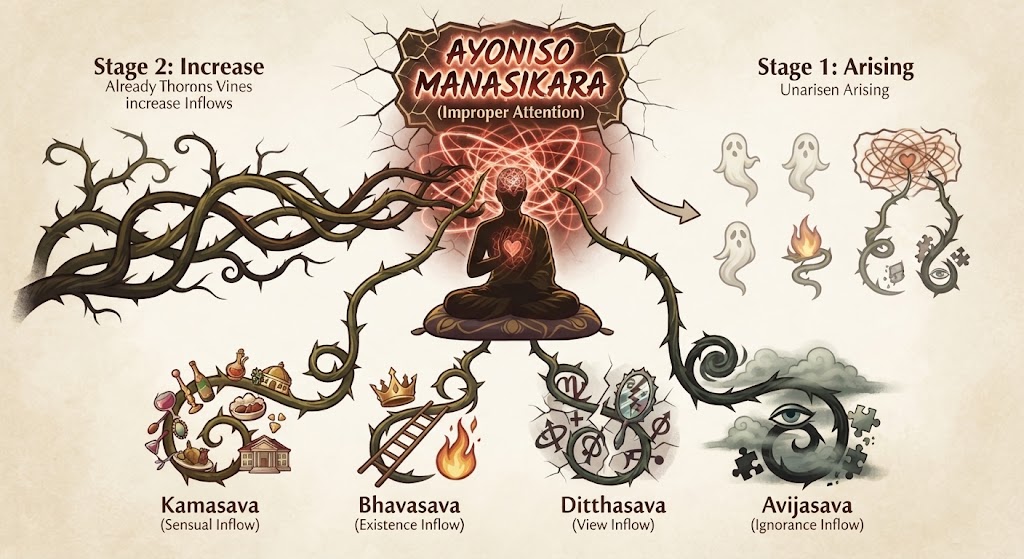
When one improperly attends to things that should not be attended to, unarisen sensual inflows (kamasava), existence inflows (bhavasava), view inflows (ditthasava), and ignorance inflows (avijasava) arise, and already arisen inflows increase. The primary cause that compels unarisen inflows to arise and arisen inflows to multiply in this manner is ayoniso manasikara (improper attention). A detailed explanation regarding these inflow-dhammas was provided earlier in the chapter titled "The Three Bonds"; here, our focus is specifically directed toward the nature of attention that drives the removal of defilements.
◼ Thinking That Eradicates Defilements
To enter the path to Nibbana and eradicate inflows, certain specific dhammas must be contemplated. By contemplating these dhammas, sensual inflows, existence inflows, view inflows, and ignorance inflows that have arisen are eradicated, and unarisen inflows are prevented from arising. To ensure that arisen inflows are eradicated and unarisen inflows do not arise, the teaching introduces four (04) primary dhammas:
- Wisely contemplating regarding suffering as: "This is suffering—the Noble Truth of Suffering"
- Wisely contemplating regarding the origin of suffering as: "This is the cause of suffering—the Noble Truth of the Origin of Suffering"
- Wisely contemplating regarding the cessation of suffering as: "This is the cessation of suffering—the Noble Truth of the Cessation of Suffering"
- Wisely contemplating regarding the path leading to the cessation of suffering as: "This is the path leading to the cessation of suffering—the Noble Truth of the Path Leading to the Cessation of Suffering"
By wisely contemplating these Four Noble Truths, the three fetter-dhammas of sakkaya ditthi, vicikiccha, and silabbataparamasa are dispelled. The eradication of sakkaya ditthi and other such inflow-dhammas through the vision of the Four Noble Truths is also known as dassana pahanabba.
The Dhamma teaching revealed to the world by the Blessed One while delivering the Dhammacakkappavattana Sutta is precisely this Four Noble Truths Dhamma. Upon hearing this Dhamma, the ascetic Kondañña attained the Sotapatti state.
Each of the Four Noble Truths has four aspects, making a total of fourteen aspects. Namely:
- Dukkha Truth: Must be fully known (parinna databbaya).
- Samudaya Truth: Must be eradicated (pahanabba katabba).
- Nirodha Truth: Must be realized (sakkatva katabba).
- Magga Truth: Must be developed (vaddhitabba katabba).
The true realization required for grasping the Four Noble Truths involves acquiring three aspects of understanding regarding each of them, which is known as niparivatta. That is introduced as a threefold cycle:
- Knowing the truth perfectly (Sacca-nana)
- Knowing the task that needs to be performed (Kicca-nana)
- Having completed the task (Kata-nana)
Thus, for each individual Noble Truth, a threefold understanding must be attained. Obtaining this threefold understanding across all four Noble Truths is described as "the twelve-aspect knowledge and vision" (dvadasakara nana-dassana).
Kicca-nana relates to fulfilling perfection. Training for perfection and completing the practice is termed kicca-nana. Knowing each Noble Truth accurately and flawlessly is known as sacca-nana.
The twelve-aspect knowledge and vision regarding the Four Noble Truths—otherwise known as the threefold-cycled twelve-aspect knowledge—is outlined below:
- Dukkha Noble Truth – Sacca-nana
- Dukkha Noble Truth – Kicca-nana
- Dukkha Noble Truth – Kata-nana
- Samudaya Noble Truth – Sacca-nana
- Samudaya Noble Truth – Kicca-nana
- Samudaya Noble Truth – Kata-nana
- Nirodha Noble Truth – Sacca-nana
- Nirodha Noble Truth – Kicca-nana
- Nirodha Noble Truth – Kata-nana
- Magga Noble Truth – Sacca-nana
- Magga Noble Truth – Kicca-nana
- Magga Noble Truth – Kata-nana
To establish the clear understanding of the Dukkha Noble Truth, one must develop the aforementioned truth, kicca, and kata aspects in a threefold rotational manner. Understanding thoroughly that things like birth, aging, illness, and death lead to the continuous wandering of beings in samsara constitutes sacca-nana. Training for realization by witnessing these sufferings individually with the mind is kicca-nana. Achieving a complete understanding of samsaric suffering is kata-nana.
Realization of the five aggregates of clinging (pancupadananakkhandha) has a powerful bearing upon truth knowledge. The manner in which the five aggregates of clinging should be wisely contemplated was taught by the Blessed One as follows:
"Phenapindupamo rupam - vedana bubbulupama,
Maricikupama sankha - saram kadalupama,
Mayupamakhandu vicchana - dipinadicchabandhuna"
"The form aggregate is comparable to a lump of foam. The feeling aggregate is comparable to a water bubble. The perception aggregate is comparable to a mirage. The mental formations aggregate is comparable to a banana trunk. The consciousness aggregate is comparable to a magical illusion or a jugglery trick."
A person who lacks the capacity to contemplate in this manner fails to grasp the true reality of the five aggregates. They fail to understand the impermanent nature of all conditioned formations (sankhara dhammas). Due to the habit of considering unstable things as permanent, pleasurable, and as a self, they are subjected to immense suffering and affliction—namely, the suffering of birth, aging, illness, death, sorrow, grief, pain, lamentation, despair, and not getting what one desires. This is the Dukkha Noble Truth.
Because the arising of suffering due to the five aggregates of clinging causes severe affliction, a person seeks a way to escape from suffering. They seek with wisdom to find a release from being severely oppressed by suffering. Because they held onto the self-view that "this is mine, this is I, this is my self" regarding the five aggregates of clinging, they had to face immense suffering. Viewing the five aggregates as permanent, pleasurable, and as a self leads to great suffering.
Ayonisomanasikara arises due to craving. This ayonisomanasikara investigates matters in a way that leads to suffering.
The Dukkha Samudaya Noble Truth must also be understood through truth knowledge, kicca knowledge, and kata knowledge. The Noble Truth of the Origin of Suffering is perfected by eradicating the inflows that need to be abandoned. What needs to be eradicated is fully understood through truth knowledge. Investigating according to dependent origination (paticcasamuppada) allows one to understand the cause for the arising of suffering. Training oneself to eradicate the inflows that ought to be abandoned is kicca-nana. The cause of suffering is ignorance (avijja). Ignorance must be cast aside to manifest knowledge (vijja). Knowledge is the comprehension of the true nature of the world. Eradicating the inflow-dhammas that cause suffering completely is known as kata-nana.
Craving gives rise to clinging. The arising of craving toward the five aggregates of clinging acts as a cause for the mass of suffering; therefore, eradicating craving is the cause for eradicating clinging. It is a cause for eradicating all inflow-dhammas and for eradicating suffering. This is the path to cessation. One comes to understand precisely what must be realized. This is the Dukkha Nirodha Noble Truth.
In the Dukkha Nirodha Noble Truth, kata-nana represents the complete wisdom attained regarding what must be realized. What must be realized is Nibbana, which is kata-nana. The knowledge gained regarding it is known as sacca-nana, and training for the realization of Nibbana is known as kata-nana.
The Noble Truth of the Path Leading to the Cessation of Suffering must be fulfilled through truth, kicca, and kata knowledge. The path must be developed. In this context, the knowledge gained regarding the path truth is sacca-nana, practicing the path truth is kicca-nana, and bringing it to perfection is kata-nana. Specifically, developing the Noble Eightfold Path—which forms the eighth factor of the path—is what is meant. Through this, the threefold training (tisikkha)—virtue, concentration, and wisdom—is fulfilled.
Accordingly, the manasikara developed regarding the Four Noble Truths can be summarized as follows:
- Regarding the Dukkha Noble Truth: Contemplating with yoniso manasikara that "this is suffering, and it must be known purely".
- Regarding the Dukkha Samudaya Noble Truth: Contemplating with yoniso manasikara that "this is the cause of suffering, and it must be eradicated".
- Regarding the Dukkha Nirodha Noble Truth: Contemplating with yoniso manasikara that "this is the cessation of suffering, and it must be realized".
- Regarding the Dukkha Nirodha Gamini Patipada Noble Truth: Contemplating with yoniso manasikara that "this is the path to the cessation of suffering, and it must be developed".
A person who contemplates in this manner attains samma ditthi (Right View). This acts as a cause to eradicate arisen sensual, existence, and ignorance inflows, and prevents unarisen sensual, existence, and ignorance inflows from arising.
A person who wishes to attain the Sotapatti state must direct their mind with the objective of eradicating defilements residing within the five aggregates of clinging. The cause for the existence of all suffering is ayoniso manasikara, which occurs regarding the five aggregates of clinging. Therefore, the mind must be trained to eradicate defilements by contemplating the true nature of this aggregate mass. Contemplating the impermanent nature of the aggregates and their true reality gives rise to samma ditthi.
Monks and laypeople who listened to the Dhammacakkappavattana Sutta and established themselves in the Sotapatti state did so by contemplating the impermanent and true nature of the five aggregates of clinging. That is, they understood with wisdom that whatever originates is bound to cease. This realization is introduced as the arising of the Dhamma eye (dhammacakkhu).
A person who comprehends the twelve-aspect knowledge and vision to perfection attains realization of Nibbana and eradicates all defilements. This realization is recognized as the supreme samma sambuddha and pacceka buddha knowledge acquired by oneself. Based on the profound instructions received from the Blessed One, it leads to the total eradication of defilements and culminates in the attainment of the Arahant state.
The cause of samsaric suffering is the identity-view (sakkaya ditthi) held regarding the five aggregates of clinging. Instead of maintaining the view that the five aggregates are permanent, pleasurable, and a self, contemplating the true nature of the world in accordance with the three characteristics—anicca (impermanent), dukkha (suffering), and anatta (non-self)—causes unarisen inflows to be eradicated and prevents unarisen inflows from occurring. Understanding that whatever originates is bound to cease gives rise to samma ditthi. The Dhamma eye opens. Sakkaya ditthi, vicikiccha, and silabbataparamasa are eradicated, leading to the attainment of the Sotapatti state. This is known as dassana pahanabba.