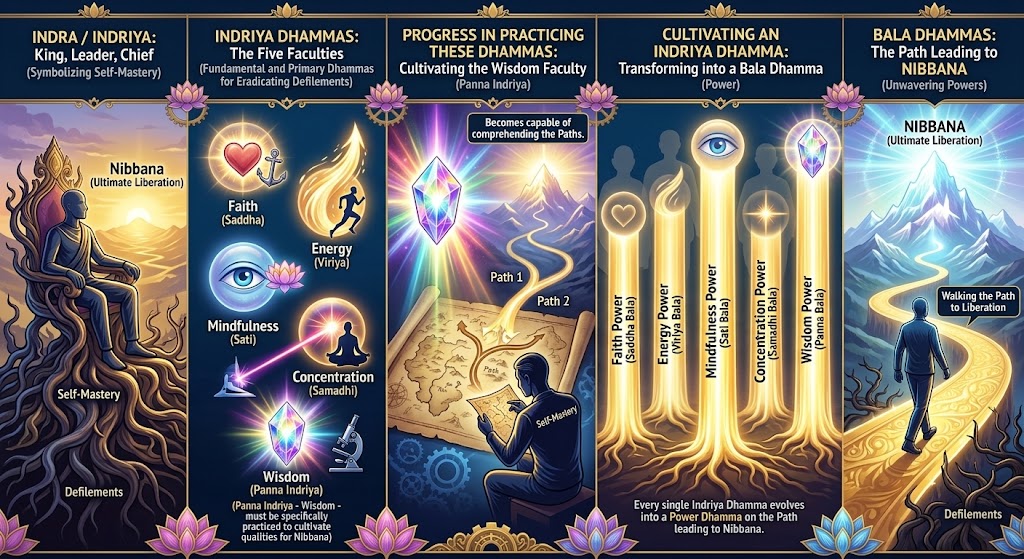
To eradicate all defilement-roots on the path to Nibbana, which opens up through the Stream-Entry (Sotapanna) path, and to attain the state of an Arahant, there are five faculties that must be progressively strengthened. They are known as the Indriya Dhammas (Faculties). Out of the twenty-two (22) Indriya Dhammas taught in Buddhism, five (5) Indriya Dhammas are especially most beneficial for Supreme Enlightenment (Sambodhi). These five dhammas are also included under the thirty-seven Bodhipakkhiya Dhammas (Factors of Enlightenment).
The five Indriya Dhammas that are most beneficial for Sambodhi are:
- Saddha Indriya (Faculty of Faith)
- Viriya Indriya (Faculty of Energy/Effort)
- Sati Indriya (Faculty of Mindfulness)
- Samadhi Indriya (Faculty of Concentration)
- Panna Indriya (Faculty of Wisdom)
"Indra" is a word that conveys meanings such as king, leader, or chief. The word "Indriya" is also used in that very sense. Because they are fundamental and primary dhammas for eradicating defilements, they bear the name Indriya Dhammas. To cultivate the qualities required for Nibbana, the aforementioned Panna Indriya dhamma must be practiced. As one progresses in practicing these dhammas, one becomes capable of comprehending the paths. Cultivating an Indriya dhamma means transforming it into a Bala dhamma (Power). That is, every single Indriya dhamma evolves into a power dhamma on the path leading to Nibbana.
The Indriya dhammas that are thus developed as Bala dhammas are listed below:
- Saddha Bala (Power of Faith)
- Viriya Bala (Power of Energy)
- Sati Bala (Power of Mindfulness)
- Samadhi Bala (Power of Concentration)
- Panna Bala (Power of Wisdom)
To develop these Indriya dhammas into Bala dhammas, one must have the aspiration to eradicate the defilements of samsara with respect to the path leading to Nibbana.
Here, some people practice the Indriya dhammas taking the Saddha Indriya as the leader, while others practice them taking the Panna Indriya as the leader. Cultivating the Indriya dhammas into Bala dhammas occurs by making either faith (saddha) or wisdom (panna) primary.
An Indriya dhamma practitioner grounded in faith is called Saddhanusari (Faith-follower). At the realization of Nibbana, the Saddhanusari noble disciple is called Saddhavimutta (Liberated by faith). Among the Indriya dhammas, a practitioner who develops them by taking Panna Indriya as the leader is called Dhammanusari (Dhamma-follower), and upon realizing Nibbana, they are called Pannavimutta (Liberated by wisdom). A noble disciple on the Stream-Entry path who has reached the state of Saddhanusari or Dhammanusari will not pass away without attaining Stream-Entry (i.e., they will not die as a non-stream-enterer).
Let us examine how each Indriya dhamma transforms into a Bala dhamma in this chapter.
01. Saddha Indriya (Faculty of Faith)
Saddha means trust and clarity. Since Saddha takes leadership and preeminence among all Indriya dhammas when acting with Saddha as its foundation, Saddha is an Indriya dhamma. By moving forward from a gentle nature, Saddha grows like a power.
The unshakable trust in the Triple Gem—namely, the Supreme Buddha, the sublime Dhamma preached by Him, and the community of disciples practicing that Dhamma—is regarded as Saddha. In addition, the belief in the eight bases regarding the Buddha (Buddha-ādi aṭṭhaṭṭhāna) is also considered Saddha. The Buddha-ādi aṭṭhāna are:
- Faith regarding the Teacher (Buddha)
- Faith regarding the Dhamma
- Faith regarding the Sangha
- Faith regarding the Threefold Training
- Faith regarding Past Lives (Pubba Bhava)
- Faith regarding Future Lives (Apara Bhava)
- Faith regarding Both Past and Future Lives
- Faith regarding Dependent Origination (Paṭiccasamuppāda Dhamma)
Eradicating disbelief in these matters and establishing trust is called Saddha.
Furthermore, Saddha is explained as clarity (pasāda). Just as a water-clerifying gem belonging to Emperor Cakkavatti, when placed in muddy water, causes the silt to settle and the muddy, unclear water to become pure, similarly, when the mind is grounded in Saddha, it becomes radiant because the hindrances (nivarana dhammas) that obstruct wholesome deeds become subdued. Because Saddha becomes fundamental, a mind filled with clarity can direct itself toward many wholesome actions.
When performing wholesome deeds with Saddha at the forefront, it takes leadership and preeminence. Saddha is considered an Indriya dhamma for that reason. It acts as a cause for the eradication of defilements and for the growth of wholesome qualities. Saddha takes leadership. Saddha is compared to a seed. A seed of Saddha grants the exalted goal of Nibbana to living beings. Taking preeminence among all dhammas, Saddha acts as a power and bestows the peace of Nibbana upon living beings.
The Saddha Indriya must be made functional by grounding it in the four factors of Stream-Entry. Namely:
- Sappurisa Sevana (Association with good/wise people)
- Saddhamma Ssavana (Listening to the True Dhamma)
- Yoniso Manasikara (Wise attention)
- Dhammanudhamma Patipada (Practice in accordance with the Dhamma)
As detailed in the previous chapter regarding these factors of Stream-Entry, it is not expected to repeat those specific points here. Each of these Stream-Entry factors is explained both as making the Saddha Indriya powerful and as developing Saddha as a power dhamma.
Through Sappurisa Sevana (also known as Kalyana-mitta sevana), one enters the path of the Dhamma, listens to the True Dhamma, and the practitioner following that Dhamma—the noble disciple—recognizes the Supreme Buddha as an incomparable being. This point is expressed by the phrase: "Yo dhammam passati so mam passati" (He who sees the Dhamma sees me). If someone practices the Dhamma, they can clearly recognize that the Supreme Buddha is such an extraordinary person, that His Dhamma is such a supreme dhamma, and that the noble disciples practicing this Dhamma form such an extraordinary assembly. From this, an unshakable faith in the Triple Gem arises.
Another result of Dhammanudhamma Patipada is that the person becomes established in morality pleasing to the noble ones (ariya-kanta sila). That is, possessing the virtuous quality of morality consisting of eight factors. Namely:
- Not having broken limbs
- Not having holes
- Not having spots
- Not having blemishes
- Being liberating
- Being praised by the wise
- Being uninfluenced by clinging/misviews
- Conducive to concentration
Thus, becoming perfected in this noble-pleasing morality makes the development of the Saddha Indriya and its manifestation as a power dhamma clearly visible.
Through the growth of the aforementioned Stream-Entry factors, Saddha is augmented. By centering upon Saddha and growing the Stream-Entry factors, the noble disciple develops an irreversible, unwavering state of mind regarding the teachings of the Supreme Buddha and the noble disciples engaged in fulfilling the True Dhamma. This is also known as Akaravati Saddha (Faith based on reasons/aspects). Thus, unshakable faith in the Triple Gem, coupled with morality that conduces to unwavering faith, listening, and concentration, acts as a cause for attaining Stream-Entry.
Taking the Saddha Indriya as a foundation, a Saddhanusari person who fulfills these Dhamma factors steps onto the Stream-Entry path and swiftly attains Nibbana realization. The noble superior who attains Nibbana in this manner is known as Saddhavimutta.
02. Viriya Indriya (Faculty of Energy)
Viriya, or effort, is an Indriya dhamma. When entering the path to Nibbana, viriya is a power dhamma for the wise noble disciple. Because viriya takes leadership and preeminence among all other Indriya dhammas wherever it is fundamental, viriya is also regarded as an Indriya dhamma.
Qualities such as fortitude (dairya), accomplished nature, enthusiasm, striving (vayama), persistence (parakkama), and exertion (padana) are spoken of in relation to viriya. It is stated as Samma Vayama (Right Effort) in the Noble Eightfold Path and as the Viriya Paramita among the Perfections.
Here, viriya is explained as an enlightenment factor (bojjhanga) that is helpful for enlightenment, under the name Viriya Sambbojjhanga. Viriya sambbojjhanga is explained through two divisions:
- Kayika Viriya (Physical Effort)
- Cetasika Viriya (Mental Effort)
Kayika viriya is considered as effort connected with tasks based on the body. Accordingly, kayika viriya operates regarding material matters. The sluggish conditions, fatigue, and weariness that can arise when a person performs physical labor for the sake of their goals can be overcome by physical effort, which gives the strength to march onward toward the target.
In performing tasks involving physical exertion, this viriya must be increased. A sluggish or lazy person fails to reach their goal in physical tasks and falls into defeat. Therefore, cultivating physical viriya is a heavily influential factor for worldly progress.
The second is Cetasika Viriya (Mental Effort). This is immaterial and mental in nature. It is bound up with wholesome qualities. Cetasika viriya is the effort generated mentally or psychically.
When a person gives charity or engages in wholesome deeds, the exertion made to keep the mind subdued from lower thoughts and the mental effort made to increase wholesome roots is cetasika viriya, which is a bojjhanga (factor of enlightenment). On the path to Nibbana, increasing mental viriya is described as more fruitful and productive than physical viriya. The Bodhisattvas uttered the four Sammappadhana Viriya for the sake of Buddhahood, which represent the physical and mental viriya seen here.
There are several fundamental factors for generating and maintaining the viriya sambbojjhanga until the attainment of Nibbana. They are:
Aṭṭhi, nikkhepe, ārambhadhātu nikkamadhatu parakkamadhātu. Taṭṭhu yoniso manasikārabahulīkāro - ayamāharō anuppannassa vā viriyasambojjhaṅgassa uppādāya, uppannassa vā viriyasambojjhaṅgassa bhāvanāya pāpuriyā
That is, meditating wisely and abundantly on the elements of initiative, departure, and exertion—known as yoniso manasikāra—is the fundamental factor that brings about viriya.
There are three stages where yoniso manasikara must be practiced. They are:
- Arammbha Dhatu (Element of Initiation)
- Nikkamma Dhatu (Element of Departure)
- Parakkama Dhatu (Element of Exertion)
Here, arambha dhatu is the initial commencement; initiating something is known by this name. Nikkamma dhatu is the viriya that distances one from laziness. The nature of remaining inactive without completing a task no matter how far one has advanced can be described as parakkama dhatu.
In addition, an eleventh-fold set of factors influencing the perfection of viriya is presented. They are:
- Fear arising upon reflecting on the lower realms (apaya)
- Knowing the benefits of viriya
- Reviewing the path of supreme ones like the Buddhas
- Respecting the alms given by faithful donors
- Constantly remembering that one has inherited a teaching showing the way to Nibbana
- Constantly remembering the preciousness of the Teacher's dispensation
- Being a noble son born into the lineage of the Buddhas
- Reviewing the greatness of those who completed the sequence
- Driving away laziness
- Associating with individuals who possess viriya
- Having a mind inclined and drawn toward viriya
In the Vaddhavanti Sutta, viriya is described through the example of a horse: just as a thoroughbred royal horse moves swiftly, actively, and fast compared to a low-breed horse, viriya is similar—swift, active, and fast. Because of this nature, viriya is equal to the thoroughbred horse's speed.
The manner of practically applying viriya toward mental dhammas is explained in the Satipatthana Sutta: One knows, "Viriya sambbojjhanga exists in me," or when it is absent, knows, "Viriya sambbojjhanga does not exist in me." One also knows how an unarisen viriya sambbojjhanga arises, and how an arisen viriya sambbojjhanga grows.
Thus established and wisely reflected upon, this same established viriya leads to the vast growth of sambodhi, meaning Nibbana. When explained as an Indriya dhamma, viriya is called the Four Sammappadhana Viriya. Namely:
- Preventing unarisen unwholesome dhammas
- Eradicating arisen unwholesome dhammas
- Generating unarisen wholesome dhammas
- Developing and cultivating arisen wholesome dhammas
Thus, working to increase wholesome dhammas and eradicate unwholesome dhammas with a mind full of intense enthusiasm using initial viriya is the Viriya Indriya. When viriya arises as an Indriya in someone's mind, it surpasses all other Indriya dhammas and attains leadership.
Here is the English translation of the provided text from "Sothapanna Watha":
03. Sati Indriya (Faculty of Mindfulness)
Sati means mindfulness (memory/awareness). Sati is an Indriya dhamma. In the Noble Eightfold Path, it is taught as Samma Sati, and among the enlightenment factors, it is stated as the Sati Sambojjhanga dhamma. For the wise noble disciple, sati or the mindfulness faculty provides leadership in moving forward on the path to Nibbana. Once sati is developed, it becomes manifest as a power dhamma.
Sati can be explained by dividing it into two main parts when elucidating it:
- Sati generated regarding internal dhammas
- Sati generated regarding external dhammas
The mindfulness that needs to be generated regarding the internal and external aspects of a person is explained in these two ways.
The 'sati' generated by a person regarding their own mental behaviors is shown as internal sati. That is, the mindfulness generated regarding the objects taken by the five sense faculties. When the eye takes a form as an object, the feeling that arises therefrom, or the mental/psychic nature of the consciousness generated in association with it—the 'sati' generated regarding these is called internal sati.
Recognizing the nature of the objects arriving at the mind is discussed here. When an object arises, the judgment of whether it is a wholesome object or an unwholesome object can be described as sati generated regarding internal dhammas.
Sati generated regarding external dhammas is yet another division. That is maintaining mindfulness regarding external objects, phenomena, behaviors, etc. When walking, standing, etc., the mindfulness generated with the feeling that "I am doing this" while performing that action can be seen as sati generated regarding external dhammas.
Accordingly, generating mindfulness regarding mental behaviors is explained as 'internal sati', and generating it regarding external activities is explained as 'external sati'.
There are causes that affect the arising of sati and the growth and fulfillment of born sati. Namely:
"Kō ca, bhikkhave, āhārō anuppannassa vā satisambojjhaṅgassa uppādāya, uppannassa vā satisambojjhaṅgassa bhāvanāya pāpuriyā? Atthi, bhikkhave, satisambojjhaṅgatṭhānīyā dhammā. Tattha yōnisōmanasikārabahulīkārō - ayamāhārō anuppannassa vā satisambojjhaṅgassa uppādāya, uppannassa vā satisambojjhaṅgassa bhāvanāya pāpuriyā."
"Monks, what is the nutriment for the arising of an unarisen sati sambojjhanga and for the fulfillment of the development of an arisen sati sambojjhanga? Monks, there are dhammas that are the basis for the sati sambojjhanga. Frequent wise attention (yoniso manasikara) to them—this is the nutriment for the arising of an unarisen sati sambojjhanga and for the fulfillment of the development of an arisen sati sambojjhanga."
Accordingly, the cause for the arising of sati is frequent wise attention. Frequent wise attention acts as a cause for the arising of sati, the development of arisen sati, and its culmination. The fundamental cause affecting the arising, development, and culmination of sati is stated as frequent wise attention. That is, the abundant development of yoniso manasikara. It is the 'yaniya' dhamma applicable to establishing sati. Accordingly, continuously abiding in mindfulness—which means establishing internal and external dhammas—causes the yogi to establish sati. It is stated that abiding in mindfulness regarding one's external activities and internal mental activities is what causes sati to arise.
The dhammas influencing the establishment of sati are introduced as nutriment. Nutriment is a nourishing factor. Reflecting wisely with established mindfulness and cultivating it is a cause affecting the arising, development, and culmination of sati. Therefore, with the thought that sati must be generated, one must constantly see with wisdom into the mind at every moment and act with established mindfulness. The Satipatthana Sutta also clarifies these very points. Therein, establishing mindfulness takes place as contemplation of the body (kayanupassana), contemplation of feelings (vedananupassana), contemplation of the mind (cittanupassana), and contemplation of mental objects (dhammanupassana).
The Vaddhavanti Ratan Sutta can be seen as a discourse by the Supreme Buddha illustrating the importance of sati. Among the seven treasures acquired by a Cakkavatti king, the Wheel Treasure is foremost. It is the treasure obtained first, and it surpasses all other treasures.
The sati bojjhanga is like the Wheel Treasure. Just as the Wheel Treasure surpasses all other treasures, sati surpasses all mundane (vattabhumiya) dhammas. Mundane dhammas are the four: sense-sphere (kamavacara), form-sphere (rupavacara), formless-sphere (arupavacara), and lokuttara (supramundane). Sati is what protects all these things, protects living beings from falling into all places, and leads them to Nibbana, which is the supramundane realm.
Sati is introduced above as a fundamental dhamma for bestowing mundane and supramundane happiness upon beings. Sati is what causes the birth or attainment of goodness or good destinations for anyone. It is also the factor influencing the realization of Nibbana. Accordingly, the sole 'yaniya' dhamma associated with the establishment of sati is sati itself. Its fundamental hallmark is reflecting wisely. Reflecting with abundant wisdom serves as the cause for the arising of the sati bojjhanga.
In addition, there are four dhammas (04) that serve as causes for the arising of sati. Namely:
- Vimamsa Sata (Inquiring mindfulness)
- Not associating with individuals who lack mindfulness
- Associating with individuals who possess established mindfulness
- Deeply inclining the mind for the establishment of mindfulness
The internal and external factors necessary for a person to generate sati or mindfulness through the above four reasons have been shown.
When sati is taken as an Indriya dhamma, four ways in which it must be cultivated are presented below:
"Katamo ca, bhikkhave, satindriyaṁ? Idha, bhikkhave, ariyasāvako satimā hoti paramena satinepakkena samannāgato cirakatampi cirabhāsitampi saritānussaritā. Sō kāyē kāyānupassī viharati..."
"And what, monks, is the faculty of mindfulness? Here, monks, the noble disciple is mindful, possessing supreme mindfulness and discrimination, one who remembers and recollects what was done and said long ago. He dwells contemplating the body in the body..."
"...vedanāsu... cittē... dhammesu dhammānupassī viharati ātāpī sampajānō satimā, vineyya loke abhijjhādomanassaṁ. Idaṁ vutratha bhikkhave, satindriyaṁ."
"...contemplating feelings in feelings... mind in mind... mental objects in mental objects, ardent, clearly comprehending, mindful, having removed covetousness and grief regarding the world. This is called, monks, the faculty of mindfulness."
These four factors are presented above as follows:
- Kayanupassana (Contemplation of the body)
- Vedananupassana (Contemplation of feelings)
- Cittanupassana (Contemplation of the mind)
- Dhammanupassana (Contemplation of mental objects)
These four satipatthanas show the manner in which mindfulness must be established. That is, how mindfulness can be established internally and externally. Observing with wisdom the four factors mentioned above in order to subdue greed and sorrow (delight and aversion) while generating further viriya and mindfulness is what is shown here.
Those are the four satipatthanas—the manner in which mindfulness must be established. Here, the way mindfulness can be established internally and externally is shown. Establishing mindfulness in this manner becomes a cause for enlightenment.
Here is the English translation of the provided text from "Sothapanna Watha" (covering pages 47 to 52):
04. Samadhi Indriya (Faculty of Concentration)
Samadhi means the oneness of the mind (concentration). Samadhi is a Bodhi-anga (enlightenment factor) dhamma. In the Noble Eightfold Path, it is taught as Samma Samadhi. Samadhi is also taught in the Dhamma as an Indriya dhamma. Samadhi is shown as having two divisions, namely:
- Samadhi with vitakka and vicara
- Samadhi without vitakka and vicara
Samadhi with vitakka and vicara is established when there is an awareness of having a mental object and how that object behaves in the mind, while samadhi without vitakka and vicara arises along with the realization of Nibbana.
According to the Vaddhavanti Sutta, samadhi is compared to the gahapati (householder) treasure among the golden treasures possessed by a Cakkavatti (wheel-turning) king. In every circumstance where it is needed, it brings wealth, relieves mental distress, and unifies the mind. Samadhi similarly cuts through the distress in a person's mind and unifies it.
There are causes that affect the generation of this samadhi—meaning the state of mental unification—and its progression to a state of abundance. They are stated as follows:
"Kō ca, bhikkhave, āhārō anuppannassa vā samādhisambojjhaṅgassa uppādāya, uppannassa vā samādhisambojjhaṅgassa bhāvanāpāpuriyā? Atthi, bhikkhave, samatinimittaṁ, avyagganimittaṁ. Tattha yōnisōmanasikārabahulīkārō - ayamāhārō anuppannassa vā samādhisambojjhaṅgassa uppādāya, uppannassa vā samādhisambojjhaṅgassa bhāvanāpāpuriyā."
"Monks, what is the nutriment for the arising of an unarisen samadhi sambojjhanga and for the fulfillment of the development of an arisen samadhi sambojjhanga? Monks, there is the sign of concentration, the sign of non-scattering. Frequent wise attention (yoniso manasikara) to them—this is the nutriment for the arising of an unarisen samadhi sambojjhanga and for the fulfillment of the development of an arisen samadhi sambojjhanga."
That is, focusing on a steadfast object, leading the mind to unify, and continuously reflecting with wise attention serve as causes for the arising and development of samadhi. Likewise, not practicing wise attention regarding the mind, but rather frequent unwise attention, acts as a hindrance to samadhi.
Furthermore, eleven factors influence the acquisition and development of samadhi. Namely:
- Vathupisadakiriya (Cleansing internal and external objects)
- Indriyasamanupadanata (Balancing the faculty powers such as faith)
- Nimittakusalata (Skillfulness in grasping the sign of meditation objects like kasina)
- Samaye cittassa paggahanata (Exerting the mind at the proper occasion)
- Samaye cittassa niggahanata (Restraining the mind at the proper occasion when its speed needs to be curbed)
- Samaye sampagansanata (Gladdening or cheering the mind at suitable occasions)
- Samaye upekkhanata (Remaining equanimous/neutral towards the mind when it is properly balanced in meditation)
- Asamahinapuggalaparivajjana (Avoiding individuals who lack concentration)
- Samahinapuggalasevana (Associating with individuals who possess concentration)
- Jhanavimokkhipavavekkahana (Reflecting upon jhana and liberation paths)
- Tadayimuttata (Having a mind deeply inclined toward the arising of the samadhi bojjhanga)
When samadhi arises in a person's mind, it surpasses all other faculty dhammas and reaches a primary position, functioning as a powerful force. In this manner, the noble disciple cultivates the samadhi indriya up to the fourth jhana.
05. Panna Indriya (Faculty of Wisdom)
Wisdom (panna) is an indriya dhamma and is also considered a Bodhipakkhiya dhamma. For the noble disciple traveling on the path to Nibbana, cultivating the faculty of wisdom is of utmost importance.
The Dhamma explains the faculty of wisdom as follows:
"Katama'vaha, bhikkhave, pannindriyam? Idha, bhikkhave, ariyasavako panna hoti udayatthagaminiya pannaya samannagato ariya nibbedhikaya samma dukkkhakkhayamagamaniya. So 'idam dukkhan' ti yathabhutam pajanati, 'ayam dukkhasamudayo' ti yathabhutam pajanati, 'ayam dukkhanirodo' ti yathabhutam pajanati, 'ayam dukkhanirodhagamini patipada' ti yathabhutam pajanati - idam vuccati, bhikkhave, pannindriyam. Imano kho, bhikkhave, pannindriyani."
"And what, monks, is the faculty of wisdom? Here, monks, the noble disciple is wise, possessing wisdom concerning rise and fall, noble and penetrative, leading to the complete destruction of suffering. He understands as it really is: 'This is suffering'; he understands as it really is: 'This is the origin of suffering'; he understands as it really is: 'This is the cessation of suffering'; he understands as it really is: 'This is the way leading to the cessation of suffering.' This is called, monks, the faculty of wisdom."
Accordingly, the faculty of wisdom is the wisdom of rise and fall possessed by the noble disciple who knows things as they truly are. It is capable of ending all suffering by seeing the Four Noble Truths clearly with wisdom:
- Seeing clearly that this is suffering
- Seeing clearly that this is the cause of suffering
- Seeing clearly that this is the cessation of suffering
- Seeing clearly that this is the path to the cessation of suffering
Wisdom seeing the Four Noble Truths in this manner is recognized as the Panna Indriya. By using this wisdom faculty as a foundation, the noble disciple enters the Sothapanna path as a Dhammanusari (Dhamma-follower), realizes Nibbana, and is recognized as panna-vimutta (liberated by wisdom).
While the five indriya dhammas have been explained individually, entering the Sothapanna path can be initiated by making Faith (Saddha) primary, or by making Wisdom (Panna) primary as the principal pathway for developing the indriya dhammas. Ultimately, when any one of these five faculty dhammas is developed, it acts as a starting point for the growth of all the other faculties, thereby not only fulfilling the Sothapanna state but also completing all path-factors for the realization of Nibbana.